Fire safety compliance is not a one-time task. It is an ongoing responsibility that applies to every business operating from commercial premises in England, and failure to meet fire safety responsibilities can result in enforcement action, financial penalties, and increased risks to occupants. For businesses operating across London and the wider Essex region, where commercial property ranges from period-conversion offices to high-footfall retail units and busy restaurant kitchens, the specific demands of each environment differ — but the legal framework that governs them does not.
This checklist covers the key areas that responsible persons in offices, retail units, and hospitality settings should have in place — it is a practical starting point, not a replacement for a professional fire-risk assessment.
The Legal Foundation
The Regulatory Reform (Fire Safety) Order 2005 places responsibility for fire safety firmly with the “responsible person” — typically the employer, building owner, or person in control of the premises. That responsibility includes carrying out or commissioning a suitable fire risk assessment, implementing any actions it identifies, maintaining fire safety systems, and training staff. Compliance is not optional, and the Health and Safety Executive, local fire authorities, and fire and rescue services all have enforcement powers where standards are not met.
Office Buildings
Fire Risk Assessment
A fire risk assessment is required for all relevant non-domestic premises. Where a business has five or more employees, the significant findings must be recorded. It should be reviewed whenever a significant change occurs — a structural alteration, a change in occupancy, or a new process that affects fire load.
Detection and Alarm Systems
Offices must have a fire detection and alarm system appropriate to the size and layout of the building. The required fire alarm category depends on the building type, occupancy, risk assessment and BS 5839-1-2025 recommendations. Higher-risk premises may require enhanced detection coverage. Alarm systems should be tested weekly and serviced at least twice a year by a competent professional.
Escape Routes
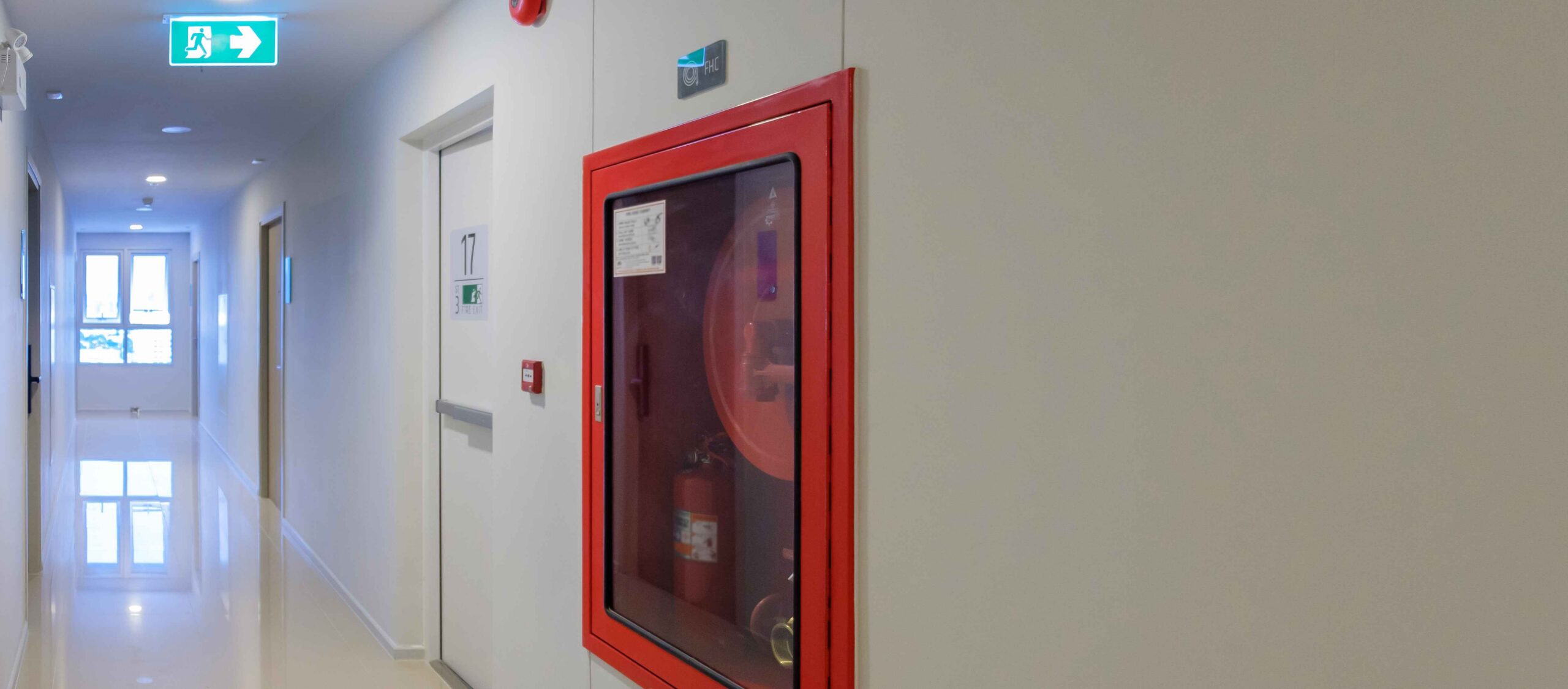
All escape routes should be clearly marked, unobstructed, and lit with emergency lighting independent of the main power supply. Fire doors must be kept in proper working condition and not propped open.
Fire Extinguishers
Appropriate fire extinguishers must be positioned throughout the building, checked annually, and replaced or recharged as required.
Retail Units
Retail environments present a distinctive set of fire safety challenges. High public footfall, fluctuating stock levels, seasonal layout changes, and extended opening hours all affect the fire risk profile of the premises — and that profile can shift considerably from one week to the next.
Stock Management and Fire Load
Combustible stock introduces a variable fire load that changes with every delivery and every seasonal reset. Storage areas require particular attention as part of any fire risk review, and access to fire exits and extinguisher points must be maintained at all times — stock placement that blocks either creates a compliance failure that can quickly go unnoticed in a busy retail environment.
Sprinkler and Suppression Systems
Larger retail units — particularly those exceeding certain floor area thresholds — may be required to install sprinkler systems or alternative fire suppression measures as a condition of planning permission or building regulations compliance. Whether this applies to your premises is a question best confirmed during a professional fire risk assessment.
Staff Training
Every member of staff should be familiar with the evacuation procedure and understand their role within it, including how to assist customers who may need additional support to evacuate safely. In retail settings with high visitor turnover and variable staffing levels, regular refresher training is especially important.
Hospitality Businesses
Of the three sectors covered in this checklist, hospitality presents the most complex fire safety environment. Restaurants, hotels, and licensed premises combine commercial cooking equipment, large numbers of members of the public, alcohol consumption, and premises that routinely operate late into the night — a combination that places particular demands on fire detection, suppression, and evacuation planning.
Kitchen Fire Suppression
Commercial kitchens are among the highest-risk areas in any hospitality premises. Commercial kitchens may require specialist fire suppression systems, particularly where high-risk cooking equipment is used. The appropriate solution should be determined through a fire risk assessment. These systems operate independently of the building’s main fire alarm and must be serviced by engineers qualified to work on suppression installations.
Sleeping Accommodation
Hotels, guesthouses, and any premises providing sleeping accommodation carry additional responsibilities under the Regulatory Reform (Fire Safety) Order 2005. Appropriate fire detection, alarm systems and compartmentation measures must be in place to protect escape routes and allow safe evacuation—including for guests who may be unfamiliar with the building’s layout or who may be asleep when a fire is detected.
Alcohol and Late-Night Occupancy
Licensed premises must be able to demonstrate that their fire safety procedures account for the specific risks that come with alcohol consumption and late-night operation. Evacuation in these conditions is meaningfully different from a standard daytime scenario — procedures should reflect that, and staff should be trained and confident in managing it.
Where IQ Fire Solutions Can Help
IQ Fire Solutions provides commercial fire alarm maintenance across London and Essex, supporting businesses in all (but not limited to) three sectors with fire alarm servicing, fire risk assessments, emergency lighting, and fire suppression system maintenance — all carried out by BAFE-accredited engineers working to current British Standards.
If your premises are due for a fire risk review, a system service, or an independent assessment of your current compliance position, get in touch with our team on 020 8500 9885 or through our website.
Frequently Asked Questions
How often does a fire risk assessment need to be reviewed?
– A fire risk assessment should be reviewed regularly and whenever a significant change occurs — such as a change in occupancy, structural alteration, or a new process that affects fire load. There is no fixed statutory interval, but annual reviews are considered best practice.
- Every 6 Months: Recommended for high-risk premises, such as care homes, high-rise buildings, or properties with complex sleeping accommodation. [1, 2]
- Every 12 Months: The universally accepted minimum standard for standard-risk commercial buildings (offices, shops, and warehouses) and Houses in Multiple Occupation (HMOs). [1, 2]
- Every 24 Months: Permitted for low-risk, modern, low-rise buildings with stable occupancy and minimal hazards. [1, 2]
- Every 3 to 5 Years: While annual checks are reviews, a completely new, full reassessment should be drafted from scratch within this timeframe to account for gradual building degradation
What fire alarm system does my office building need?
– The appropriate system depends on the size, layout, occupancy and risks of the building. IQ Fire Solutions can advise on the right specification for your premises.
Are restaurants legally required to have kitchen suppression systems?
– Commercial kitchens operating above cooking equipment are expected to have appropriate fire suppression measures in place as part of their fire risk management. The specific requirement depends on the type and volume of cooking being carried out.
How often must fire alarm systems be serviced in commercial premises?
– Fire alarm systems should be maintained and serviced at intervals recommended by relevant standards and system requirements. In many commercial settings, servicing is carried out at a minimum of every six months by a competent engineer.
What is a “responsible person” under the Regulatory Reform (Fire Safety) Order 2005?
– The responsible person is the individual in control of the premises — typically the employer, building owner, or occupier — who holds legal responsibility for fire safety compliance, including commissioning and acting on fire risk assessments.